Showing posts with label shaklee prenatal support. Show all posts
Showing posts with label shaklee prenatal support. Show all posts
Friday, June 16, 2017

Shaklee Vita-E Selenium Prenatal Support
 Shaklee Prenatal Support- Vita-E plus Selenium
Each serving of Shaklee Vita-E contains 400 IU of vitamin E plus 10 mcg of selenium to promote a healthy pregnancy.
Tuesday, June 13, 2017
Shaklee Vitamin D3 Prenatal Support
Shaklee Prenatal Support- Vita-D3
One Tablet of
Shaklee Vita-D3 contains 1,000 IUs of vitamin D to help support
a healthy pregnancy.
Shaklee Iron + C Prenatal Support
 Shaklee Prenatal Product- Iron + C
One tablet of
Shaklee Iron plus C Complex contains 18 mg of highly-potent
iron and 60 mg of vitamin C to help support a healthy pregnancy.
Tuesday, June 6, 2017
Shaklee Vita-lea Prenatal Support
 Shaklee Prenatal Product- Vita-lea
One serving of
Vita-lea with iron multivitamin contains the following pregnancy supporting
nutrients: vitamin A (5,000 IU), vitamin C (120 mg), vitamin D (800 IU),
Folate (800 mcg), calcium (450 mg), iron (18 mg), iodine (200 mcg),
magnesium (200 mg), selenium (70 mcg)
Shaklee Vitalizer Prenatal Support
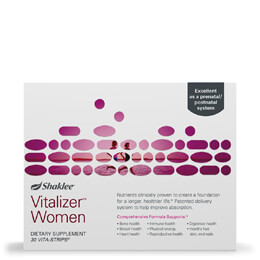 Shaklee Prenatal Product- Vitalizer Women
Shaklee Vitalizer Women is excellent as a prenatal/postnatal pregnancy multivitamin. Each vita-strip provides a full spectrum of nutritional support including 800 mcg of folic acid, 200 mcg of iodine, and 18 mg of iron.
Friday, June 2, 2017
Shaklee Prenatal Support Nutrients
Prenatal Support Nutrients


Iodine
During pregnancy and lactation, there is an increased need for iodine to produce thyroid hormones.
During pregnancy and lactation, there is an increased need for iodine to produce thyroid hormones.
Iron
Iron is essential to make hemoglobin and myoglobin to help carry oxygen to the baby.
Folic Acid
Supplementing with 400-800 mcg of folic acid significantly reduces the incidence of neural tube defects.
Iron is essential to make hemoglobin and myoglobin to help carry oxygen to the baby.
Folic Acid
Supplementing with 400-800 mcg of folic acid significantly reduces the incidence of neural tube defects.
Omeg-3 fatty acid EPA & DHA
EPA supports the heart and immune system and DHA plays an important role in the development of brain, eyes, and central nervous system. Recommended dose is 500 mg/day of EPA & DHA combined with 200 mg coming from DHA.
EPA supports the heart and immune system and DHA plays an important role in the development of brain, eyes, and central nervous system. Recommended dose is 500 mg/day of EPA & DHA combined with 200 mg coming from DHA.
Lean Protein
While a baby is developing, your need for protein goes up. Soy, egg whites, lean meats, and non or low-fat milk.
While a baby is developing, your need for protein goes up. Soy, egg whites, lean meats, and non or low-fat milk.
Vitamin A
Vitamin A is essential for immune function as well as reproductive and fetal health. Experts recommend supplementing with 2500 to 8000 IUs per day.
Vitamin A is essential for immune function as well as reproductive and fetal health. Experts recommend supplementing with 2500 to 8000 IUs per day.
Antioxidants
Vitamin C, E & Selenium can help protect the cells in the reproductive system from oxidative stress both before and during pregnancy.
Vitamin C, E & Selenium can help protect the cells in the reproductive system from oxidative stress both before and during pregnancy.
Calcium, Zinc, & Magnesium help
to build the baby's health bones and teeth and help to protect the mother's bone
density.
Vitamin D
Vitamin D supports brain development and increase the absorption of calcium. If the mother has a vitamin D deficiency there will be very low vitamin D in her breast's milk. Therefore, vitamin D continues to be important during breast feeding.
Vitamin D supports brain development and increase the absorption of calcium. If the mother has a vitamin D deficiency there will be very low vitamin D in her breast's milk. Therefore, vitamin D continues to be important during breast feeding.
Watch Pregnancy Nutrition Video
Subscribe to:
Posts (Atom)